Wednesday, July 22, 2009

Synthesis Gets Interesting

As a pleasant surprise, there's quite a bit of activity and emerging excitement in the area of synthesis, just in time for this year's DAC.

Physical Synthesis

Oasys Design Systems has come out of stealth mode with rather incredible performance claims.

It's exciting to hope for a revolution in synthesis. Put me in the "show-me" camp. It's (relatively) easy to meet 80% of what Design Compiler can do, but there are many features and tricks developed by DC over the years, making it a hard tool to displace. Synopsys has certainly seen strong competition, including from Ambit BuildGates (acquired by Cadence) and most recently by Get2Chip (now Cadence RTL Compiler). What often happens is not that king DC is overthrown, but that the competition lights a fire under Synopsys and their tools will improve at a much faster pace than market dominance would dictate.

What's interesting about Oasys are the tremendous claims about capacity and run time, and the emphasis on physical synthesis, combining logic synthesis with placement and optimization. The company also has impressive board members, including Sanjiv Kaul (former implementation GM at Synopsys) and, re-appearing to EDA after a long hiatus, Joe Costello (charismatic and successful former Cadence CEO).

ESL Synthesis

For several years, EDA industry analyst Gary Smith has been calling for the ascent of ESL (Electronic System Level) design. He was already called an ESL evangelist back in 2006! It's been the next big thing for a while now. It seems to follow the industry's progression from transistors to gates to RTL, but RTL remains the mainstream design method.

In the context of design implementation, ESL implies synthesis at a more abstract level than RTL. This year, there appears to be considerably more buzz, and not just from Gary. See, for example, recent posts by John Cooley and Richard Goering.

Key players include

My apologies for any I've overlooked--I'm learning about this field. One point of concern is that there isn't a consensus on design language/dialect, which varies by vendor over C, C++, SystemC, and proprietary languages/extensions. That can impede adoption. It was Design Compiler that established the de facto standard for Verilog RTL synthesis subset, and this provided a common point for customers (and competitors) to converge on.

It's nice to see continued innovation in this critical area of IC design, and merits further investigation.

Monday, July 20, 2009

Looking Forward to DAC

As most everyone is aware, the big conference in the chip design software world, DAC, runs July 26-31 in San Francisco. I'm looking forward to it and plan to be up there most days. Some prognosticators have posted their "must-see" lists. (Gary Smith, John Cooley laying out the law for aspiring vendors) and there will be more to come.

Rather than calling out specific companies, I'll share some of technologies that I'll be looking to learn more about.

Low Power
This is one of the genuinely valuable and necessary "next big things" in methodology.
Datapath
I've always been surprised that specialized datapath techniques aren't more successful. It seems like you either use an advanced RTL synthesis tool, or design datapath by hand. There's not a lot of in-between.
MCMM (Multi-Corner, Multi-Mode)
It sounds like the solution to many problems. But how well does it really work -- how scalable is it?
parallelism, multi-threaded, multi-core, GPGPU
How will EDA ever catch up to designs scaling by Moore's Law? By using the parallelism available in today's CPUs and GPUs. Multi-core is working today for 4-8 cores, but may hit a wall beyond this. And what about the tremendous parallel computational power in your Graphics Processing Unit? A few EDA tools are leveraging the CUDA platform; where will it pop up next?

Update: check out Richard Goering's interview with EDA luminary Kurt Keutzer on this topic.

Asynchronous Design
This is my token research-y interest. Synchronous design is what we all learn in school, and there's a plethora of tools (namely, the EDA industry) to automate such designs. But there are drawbacks with respect to area and power. Can we learn a new way to design, and develop new sets of IP and automation tools?

Friday, July 17, 2009

You Probably Believe We've Landed on the Moon, too

Don't believe everything you read. There's an insightful behind the scenes exposé on DeepChip about a technology web site that turns out to be a marketing venue for a group of EDA start-ups. Nothing wrong with that, but the disclosure of who's behind it took some digging and questioning to tease out.

Of course, one would be naive to assume this doesn't happen elsewhere in the media. Even Mr. Cooley's beloved DeepChip, with its purported user-generated content, can be gamed. When you read a glowing endorsement of an EDA tool, ask yourself questions such as

  • Who wrote this? Are they "anon"?
  • Did they really write it? Or could it have been "ghost written" by the EDA vendor and submitted in the customer's name?
  • What is the author's interest in the vendor? Does the author's company have a financial or other interest in the vendor's success?

Nothing beats the testimonial of someone you know and trust, other than your own hands-on evaluation.

p.s. in honor of Apollo 11's 40th anniversary, read more about Apollo Moon landing hoax conspiracy theories .

Wednesday, July 15, 2009

DAC Appeals to Users

When I first started attending DAC (1990 in Orlando), as an ASIC designer who'd recently joined an EDA group, I found it disorienting. The exhibits floor seemed like a circus with attendees rushing from one booth to the next to collect the best schwag (some things never change). I dutifully sat in paper presentations that sounded interesting, but I soon realized they weren't addressed to designers or users. I came to think of them as "PhD theses showing a routing algorithm that performed 13% better on an academic benchmark". Not to belittle those papers -- the mathematics and rigor impresses me greatly, but I don't understand all of it or apply it in my job.

Over the years, DAC has become more user friendly. The panels in particular are often informative and sometimes provocative. I find that I'm getting more and more out of DAC.

This year, there's an explicit "User Track" at the conference. I'd like to share a description of the User Track while presenting the first guest post on John's Semi-Blog. Please enjoy!

User Track at DAC:  Learn from Your Peers

Soha Hassoun
Tufts University
46th DAC Design Community Chair

Leon Stok
IBM
46th DAC New Initiatives Chair

Today’s connected world makes it possible for you to work from everywhere.  Yet, there’s only one place where you can learn how your peers successfully applied design tools to chip design and where you can exchange valuable experiences:  the new User Track at this year’s DAC.

The three-day User Track features 40 presentations that run in parallel with regular technical sessions.  Speakers include expert designers from Cisco, ClueLogic, Fujitsu, IBM, Infineon, Intel, Qualcomm, Samsung, STMicroelectronics, Sun, Texas Instruments, Virtutech, Xilinx and others.

Identifying Front-End Challenges

Power planning and verification continues to be hot.  A team from NEC will detail an automated flow to pre-characterize the power consumption of a set of basic components starting from their behavioral description in C, down to their power estimation at the gate-level netlist.  A team from Cisco will describe the use of a power noise analysis tool to analyze system power integrity.  Engineers from Texas Instruments will illustrate how they used an EDA tool to integrate complex multi-power/voltage domain design.  Intel engineers will present a flexible, high-level power management modeling and simulation framework for power architects.  And, a team from STMicroelectronics and ST-Ericsson will outline an exploratory and refinement-based power planning system.  Also, Intel engineers from India and Israel will offer a novel direction for using abstract executable models to verify power management protocols.

Tackling Backend Challenges:

In the Practical Physical Design session, a team from Intel will discuss how they tackle ECOs as late logic changes delay the process and register arrays occupy more than half of all transistors of modern designs.  Qualcomm designers will describe how they build their semi-custom methodology and STMicroelectronics engineers will outline e how they use the IP-XACT standard from Spirit to enable IP reuse.

Accurate power supply and substrate noise analysis remains a challenge, and practitioners from Qualcomm, IBM, Samsung and Kobe University will show how they attack the problem.  Texas Instrument designers will show how to analyze blocks for reuse in multiple metal stacks.  Intel engineers will highlight their approach to assessing design feasibility early in the process to avoid problems later.

A team from Stanford University, Rambus and Netlogic describes a way to tackle analog reuse as it becomes as important as reuse is in digital design.  A group from Cadence and several Taiwanese universities will describe their approach to integrate MEMs in mixed-signal designs.  Engineers from NXP and Magwel tackled the problem of analyzing substrate noise and will present their results in 90nm process technology.  With complex circuits often needing an integrated approach to physical and electrical verification, a team from SysDsoft and Mentor describes how they accomplished this on their designs.

In addition, join us for an Ice Cream Social Wednesday from 1:30pm-3pm where 42 posters will offer an opportunity for you to mingle with other EDA tool users. 

Access to the User Track is included with the full-conference registration.  Or, register separately for the User Track and get access to the keynotes, in addition to the User Track.  For more details, visit:  www.dac.com.  We look forward to seeing you in San Francisco.

###

For more information:

Nanette Collins

Publicity Chair, 46th DAC

(617) 437-1822

nanette@nvc.com

Tuesday, July 14, 2009

The Year DAC Changed Forever

There is so much good DAC material coming out; EDA is hitting critical mass in the blogosphere. There's a new social network site "I Love DAC" that ramping up, where I was delighted to see this flashback from the heydey of EDA: 1991: The Year DAC Changed Forever - The DAC Fan Club. (props to Steve Leibson)

Not only is the video entertaining, but it's a bona fide piece of EDA history. It's also worthwhile to reflect on the promise of Frameworks, still unfulfilled in EDA: seamlessly integrated multi-vendor tool flows. Well, at least it's job security for CAD engineers.

Monday, July 13, 2009

Denali DAC Festivities

The EDA company Denali is famous for their DAC parties. They are also running fun contests where the public can vote for the top EDA blogger or community superhero. See some new faces and vote for your favorites at

And, at the party itself, watch the show and vote for EDA Idols!

DAC Attendance Deals

According to John Cooley's DeepChip site, Atrenta, Denali and Springsoft will be sponsoring 600 free DAC Exhibit Hall passes this year.

John also posted that the very popular "Free Monday" deal is coming back as well. Here's what his email described:

From: Bob Gardner [bobg=user domain=edac.org]

Hi, John,

Please inform your readers that EDAC has decided to sponsor the return of "Free Monday" to DAC this year. If they want to take advantage of this "Free Monday" registration, your readers must go to:

http://www.deepchip.com/FreeMonday.html

and complete all four pages of the registration. On the THIRD page they'll find a newly added "Free Monday Exhibits" option -- they MUST check this box to get this special registration.

On the forth page they should see a web receipt with their unique bar code confirmation on it. They must print this entire page.

To enter the DAC Exhibit Hall on Monday, July 27th, the engineer must present a paper copy of his/her entire bar code page to the Advance Registration desk located in the North Lobby of Moscone Center.

See you at DAC, John!

- Bob Gardner EDAC San Jose, CA

As for me, I've already paid my $50 for the all-DAC exhibits pass. See you there. The buzz for DAC is heating up, so watch for more blog posts before the conference.

Friday, June 26, 2009

DAC on Sale

Just a quick reminder: DAC 46th Registration Rates go up after June 29, so register today to get the early discount. See you in San Francisco!

Thursday, June 25, 2009

Sean Interviews Rajeev

Though he's not as colorful as Gerry Hsu, Rajeev Madhavan, CEO of Magma Design Automation, is one of the most interesting and outspoken executives in the EDA industry. Check out Sean Murphy's Interview with Rajeev.

Rajeev founded several significant EDA companies, was apparently out-manuvered in the board room at times, and is forthcoming with what he's learned about the EDA industry and building companies.

Tuesday, June 23, 2009

EDP 2009 & the Return of ASIC

Electronic Design Process 2009 Symposium Program has links to the presentations from this April workshop in Monterey. I've never gone before, but it looks relevant and interesting.

I glanced at a few presentations and was most surprised to see predictions of the resurgence of ASIC vendors (vs. today's popular "COT" model). I'm not sure I agree, but it makes a certain amount of sense. It takes a lot of tools, people, and expertise to implement 45 nanometer chips. The proposition is that if it is possible to cleanly hand off at RTL, then the chip designer can focus on functionality, and let an implementation house focus on the tricks and traps of nanometer-scale design closure. But that's a big if, to be confident that the hand-off is of a properly constrained and realizable design!

Wednesday, June 17, 2009

Rumors of Usenet's Death Not Exaggerated

Today, I received notice from my Internet Service Provider, att.net, that they will no longer provide access to the Usenet service. This development saddens me and brings back memories of how incredibly useful Usenet was in the early days of the Internet (even pre-Web).

You could find kindred spirits of any interest available for text-based correspondence and enlightenment. I solved countless software problem (including both Windows and Linux) by searching through these groups. Who could forget groups like

  • comp.cad
  • comp.cad.cadence
  • comp.cad.synthesis
  • comp.lang.verilog
  • comp.lang.vhdl
  • comp.lsi.cad
  • sci.engr.semiconductors

Oh, and the flame wars! (I remember there was a character outraged over the Ottoman Empire who sought to cancel every post containing "turkey", which swept up Thanksgiving recipes, as well.)

The beginning of the end was when Web access took off, epitomized by "AOL newbies" pouring onto Usenet without regard to the collegial etiquette that previously existed. After AOL, there was overwhelming growth of users, which strained the scalability of worldwide discussion forums. Finally, the death knell: Spam. When I peek at Usenet groups today, they're full of the most crude and amateurish spam. It appears that posts are not run through filters as is all of our email, and this makes the noise/signal ratio unbearable.

R.I.P., Usenet. You were one of the forefathers of what we enjoy today through the Web, forums, IM, and social networking.

Tuesday, June 16, 2009

Anticipating DAC

The Design Automation Conference is coming up at the end of July in San Francisco. Expect the Silicon Valley crowd to be out in force.

There's been some griping that there's no "Free Monday" this year. Instead, there's an all-days Exhibits Pass available for $50. To me, that seems like a very reasonable proposition. It remains to be seen if this will cause a significant drop in attendance, and if those who won't pay $50 are the ones EDA vendors need to see at their booths.

As the conference approaches, there will be a number of "must-see" lists, and I hope to compile my own. Right now, I don't have a very clear idea about companies to see. I do have some ideas about what may be hot, from my ASIC design implementation-centric point of view.

What Should Be Hot

  • Multi-threaded & Multi-core software. Initially, these trails were blazed by startups such as Extreme DA and Sierra Design Automation (now part of Mentor Graphics). Now, all the major EDA vendors are working hard at either developing new products or retrofitting established ones. Richard Goering has had a number of interesting technical posts about how it's going at Cadence.
  • Multi-Corner Multi-Mode (MCMM) analysis and optimization. This has also been talked about for a long time. It's always seemed like a good idea, but is becoming more critical at the most advanced processes and design sizes. A key question is how practical this is. What is the performance penalty to go to MCMM? Helping to solve this will be multi-threaded & multi-core software.
  • Low Power. Of all the "next big thing" areas of EDA, this has struck me as the most real. There are several viable verification products based on simulation or static analysis. For implementation, there's combinational and sequential clock gating, multi-Vth optimization, and support for voltage and power domain design driven by UPF (or in Cadence's case, CPF ;-)

Ready for Prime-Time?

  • I've been doing a lot of reading about variation, and various techniques to account for this. It's a fascinating new way to think about semiconductor performance. But, there is so much that needs to fall into place for statistical techniques to be used in production: tools, libraries, and a new way of thinking about design analysis.

Count Me Skeptical

  • ESL. Maybe it's the market I'm involved in, where "QoR", especially performance, trump potential productivity gains at higher-abstraction design levels. This may be more attractive when time to market is everything and the QoR tradeoff not so great.
  • RTL analysis & design planning. Again, maybe it's because of where I sit, but you can argue about getting too carried away with analysis at RTL. RTL is the functional description of the design. Implementation can be done "downstream" of that.
So there's a stake in the ground. I'd love to hear your comments on what the hot trends and companies will be in EDA this year. Hope to see you at DAC!

Tuesday, May 19, 2009

Find Your Parachute's Color on a Library Vacation

I've recommended Nick Corcodilos' Ask the Headhunter web site before for its unorthodox, yet sensible, advice to finding the best job for you. I'd recommend that you sign up for his newsletter on the web site if you like what you see. This week, he describes taking a Library Vacation(tm) for someone contemplating a career (not just job) change. It's an exciting idea!

I've seen a few friends leaving the high-tech industry, and their transition plans sometimes could use more rigor. It seems like everyone wants to get into a "green" or "alternative energy" job! I'm sure that will be big eventually, but it's better to expand your search space, and carefully consider what you would be passionate doing.

Wednesday, May 13, 2009

Reading Larry's Tea Leaves

Ellison Insists Sun's Sparc Still Has a Future covers statements by Oracle's Larry Ellison stating the acquiring company's belief in proprietary hardware. However, in "reading between the lines", the author suggests that Oracle might seek a big partner to drive the hardware business over the long haul.

Friday, May 08, 2009

This Week in EDA M&A

Rumors are abounding and some EDA share prices are on fire! While we anxiously await "other shoes to drop", Chris Edwards provides strategic commentary on The week of the sensible deals.

Thursday, May 07, 2009

Coordinated EDA

Does the EDA industry have a roadmap? is a worthy read in its entirety, but I particularly liked
The crises are piling up — software and concurrency, analog/RF, die-package-board and die stacking — and with a fixed number of EDA R&D engineers, we need to stop working on some issues. In the big picture, who wins a power format or current-source model or process variation model war is less critical to semiconductor industry health than consensus, interoperability, and moving on to fundamental design technology challenges.

This is very consistent with the efforts of companies like TSMC to get the EDA industry working cooperatively to solve more problems and add more value, by reducing overlapping development.

Tuesday, April 28, 2009

Richard Returns, Reports on TSMC

Two quick points today:
  1. Richard Goering (noted EDA journalist) is back online! He's been covering EDA for a long time and has interesting and credible insights. He's writing a blog for Cadence at Industry Insights.
  2. I went to the TSMC Technology Symposium in San Jose last week. I've been going for the last few years. These are great for getting road maps of silicon process and design technologies (TSMC Reference Flow). I wasn't sure how much information I could share from the day, but Richard has solved my problem by writing a comprehensive report TSMC Views R&D As Ticket Out Of Recession.

    One announcement that I'd like to call attention to is TSMC's integrated sign-off flow. I'd like to take a look at it. It's initially created for 65nm sign-off, and sounds like a Reference Flow on steroids. Not only are there "approved" tools, but also recommended scripts (which EDA vendors also provide) and other libraries and technology files -- apparently a complete package. I'm curious to see how it differs from what we currently use. I might learn some new tricks.

Monday, April 27, 2009

Scaling, Integration and the 3D Shuffle

Chris Edwards wrote a great look at the future of semiconductor scaling in The 3D shuffle - Shrinking Violence Blog.

I'm seeing more and more about 3D packaging, using emerging technologies such as Through Silicon Vias (TSV). Might this solve some of the thorny integration issues people are expecting? If 3D is a good answer for Logic + Memory, it may also be a good match for CPU + GPU. Already, in the CPU space, we're seeing a fair amount of package-level multicore integration, rather than "natively" putting all the cores on a single die. For example, check out AMD No Longer Feels the Need to Go “Native” .

Monday, April 20, 2009

Why Oracle Bought Sun?

You heard it here second. Lou Covey blogged in State of the Media: Oracle. Sun. Brilliant. that Oracle's play for Sun is part of a scheme to break into the Hardware or (shudder) EDA industries!

It's a provocative theory, but would leave me very, very surprised if that were Oracle's motivation. Perhaps they could improve the financials of the EDA business, or juice up EDA's database architectures. But more likely, it seems to me is that Oracle is looking for control of software assets like Java and MySQL. The server and chip businesses just seem way beyond Oracle's core competencies. I'd guess those may be spun off or otherwise de-emphasized.

5/7 Larry says they're keeping all the hardware business.

Friday, April 17, 2009

President Obama Emphasizes Engineers' Contributions

President Obama gave a speech this week providing a vision for the American economy. He outlined "pillars" of a new economy built "on rock".

I was heartened to hear the President's recognition of the value of scientists and engineers, and their abilities to contribute to a sound economy:

one of the changes that I would like to see — and I’m going to be talking about this in weeks to come — is once again seeing our best and our brightest commit themselves to making things — engineers, scientists, innovators. For so long, we have placed at the top of our pinnacle folks who can manipulate numbers and engage in complex financial calculations. And that’s good, we need some of that. But you know what we can really use is some more scientists and some more engineers, who are building and making things that we can export to other countries.

-- The Obama Speech on the Economy - Capital Journal - WSJ

Searching for Silicon Valley


(New York Times photo)

Interested in visiting Silicon Valley, or brushing up on your technology industry history? Check out American Journeys - Searching for Silicon Valley; a Place and a State of Mind from the New York Times.

Saturday, April 11, 2009

Nano Edutainment

UC Berkeley's considerable contributions to science and engineering range from the creation of SPICE to the The Nano Song Go Bears!

Wednesday, April 08, 2009

Happy Birthday SPICE

Another day, another birthday. Coming soon is a big one, for SPICE [Wikipedia], one of the very first EDA programs. It is still vibrant and vital today, after 36 years of the semiconductor revolution.

Read more about its history and how it works in Circuit Simulation - Part One - SPICE Turns Thirty-Six. It's a nice article where you will either learn a little circuit theory, or have flashbacks of courses you took a long time ago. I used to be able to do these equations in my sleep. Let's not talk about my "current" capability.

If you'd like to learn more about SPICE, look for the blogger to post more parts in his series. There's also The SPICE Book, authored by one of the SPICE developers.

Tuesday, April 07, 2009

Happy Birthday RFC

How the Internet Got Its Rules - NYTimes.com celebrates a successful collaboration model that's 40 years old: RFC, or Request for Comments.
these humble documents shape the Internet’s inner workings and have played a significant role in its success

What history! What an achievment! It represents the best of engineering culture, to have an open dialogue to craft the best solution (brainstormimg + compromise). And, it only leaves me wondering, why can't we have more true collaborative standards in our industry?

Monday, April 06, 2009

Why Functional Programming Matters

I've always been a wannabe hardcore software engineer (it was my emphasis for my M.S.), but in reality, am JAPH.

Nevertheless, I enjoy keeping up with new software development methodologies and languages. As far as fluency, I'm in the age of Java and OOP, but I enjoyed this clear explanation of Why Functional Programming Matters in the "Daily Vim" blog.

Even if you aren't interested in new languages just for the sake of it, this snippet shows why it's relevant to strong emerging trends in CPUs, GPUs, and productive programming paradigms:

At this point, the resounding question in your mind is probably, "why bother?" Well, fortunately there's a very strong reason behind all this shifting of methodology, and that's concurrency.

Wednesday, April 01, 2009

Daily Vim: Goodbye Vim, Hello Emacs

Oh no! What a way to begin the month! Just read of the loss of a fellow traveler, going to the dark side in Daily Vim: Goodbye Daily Vim, Hello Emacs. Emacs, of course, is a prime example of Zawinski's Law.

Tuesday, March 24, 2009

EDA Industry Update

Sramana Mitra posts her latest financial analysis of the leading EDA vendors at EDA Industry Update.

Some reactions to her points:

  • Synopsys is king of the hill. Yes, obviously.
  • Cadence should acquire Magma. I could see this happening. That's the kind of thing Cadence has done in the past, and Magma is getting small.
  • Bring back Joe Costello. It would certainly energize the industry, but I doubt he'd want to, or that he could fix things alone.

Tuesday, March 17, 2009

Synopsys Lynx, a New Old Product

I'm at SNUG this week. I'll try to post more of a trip report after the fact. Aart's keynote speech yesterday was very listenable, as always. But I didn't feel there were a lot of major announcements or new insights.

One of the new announcements was a surprise to me: a flow management system called "Lynx". There's no way I can describe it better than harry … the ASIC guy � Synopsys Lynx Design System Debuts at SNUG.

I'm curious to learn more about it -- there's a SNUG session on it tomorrow. I'm a sucker for a pretty GUI, and I love automation. But I wonder how much business opportunity there is for this -- what is the target customer, and what is the value to them? Many large companies may already have something in place. But for a company just starting up a flow, this could be a quick start to "best practices" results.

Just don't call it a Framework!

Monday, March 16, 2009

Real-Time SNUG Tweets

Woz Dances to a Different Beat

Most all of you must be familiar with Steve Wozniak (personal site, Wikipedia article), legendary personal computer designer and Apple Computer co-founder. "Woz" has long been one of my hardware-design idols, alongside geniuses such as Seymour Cray (R.I.P.).

I've followed Woz's trajectory for a long time. I've seen him speak a couple of times, including as a featured guest at the Synopsys Users Group conference a couple of years ago. As a hardware engineer, you can't help but love Woz. He is truly a gifted designer, and his enthusiasm and passion are clear and sincere.

As Apple co-founder, he's a pretty wealthy guy, which gives him the luxury of pursuing whatever wild idea strikes his fancy. He's had a couple of brushes with pop culture (dating an actress/comedianne), but came out in a big way last week with an appearance on Dancing With the Stars.

You can see his debut here Wow! Woz continues to command my respect as a passionate engineer with absolutely no pretense. I can't help but laugh and wonder if this is the best "15 minutes of fame" moment for an electrical engineer, though. Rolling in on a Segway? Pink Boa? Ah, Woz, you really don't care what others think, do you? I love and respect you for that.

Tonight is his second appearance on DWTS. Hopefully it won't be his last. Check him out. And, in solidarity with our engineering brethren everywhere, give him your support. It would be sweet if some hackers got into the phone system and pumped up the votes for his performance. [the roots of Woz's technology wizardry began with "phreaking" phone systems to get free long-distance phone calls!]

Wednesday, March 04, 2009

SNUG is Coming to San Jose

It's that time of year for my favorite industry conference, SNUG: Synopsys Users Group - San Jose. I'm on the Technical Committee, so I might be biased. I hope to see you there!

At a glance:

SNUG San Jose 2009
March 16 - 18, 2009 

Location: Santa Clara Convention Center 
5001 Great America Parkway
Santa Clara, CA 95054

Here's the schedule. Contact your Synopsys support person or sign up online.

Cost-Reducing IEEE

Two years ago, in better economic times, I wrote a post Wondering about the IEEE, questioning whether being an IEEE member worth the US$140 dues.

Now, of course, the economy is in worse shape, my company is cost-reducing with a vengence, and IEEE membership is up to $169 (a 20% increase by my calculator). To put it politely, what is the IEEE thinking? It's like some government bureacracy run amok, growing on auto-pilot.

All of the concerns about benefits vs. cost, and the unease of not having a home for ASIC design and EDA, still exist. Now the cost has risen much faster than inflation and money is tighter. Time for us to part ways, until "some sunny day". (cue Vera Lynn/Pink Floyd)

Monday, March 02, 2009

Twittering Away EDA

Twitter mania is running wild! (I reserve judgement on whether this is a good thing.) In the early days, Twitter was only a factor in events like the MacWorld keynote, when so many geeks would be riffing on Steve Jobs' speech, it would crash Twitter's servers.

Now, I hear Twitter mentioned on MSNBC every five minutes (weird). And last week, Twitter came to an EDA conference. JL Gray and like-minded attendees "tweeted" their impressions of DVCon in real-time. JL followed up the conference with a recap via that "old-school" platform, blogging: Cool Verification: DVCon 2009 Wrap Up: Attendance.

I followed the DVCon tweet stream from time to time, but I felt you really had to be there. I didn't "get" many of the references, though it sometimes left me wishing for a live webcast to see what the excitement was about. Personally, I think Twitter is too hyped-up. Maybe, when most everyone is carrying a cell phone or MID with low-cost unlimited data access, it will create new ways of interacting and experiencing conferences. But for now, it is something to be figured out by early adopters.

Thursday, February 26, 2009

EDA, Dead or Alive

Almost as good as attending the DVCon panel EDA: Dead or Alive? is reading Mike Demler's notes at The World is Analog: EDA: Dead or Alive? Apparently this is the successor to John Cooley's infamous Troublemakers panel.

Peggy said EDA tools are overpriced? Huh! How about giving me a quality product that doesn't crash so often! Makes Microsoft Office look like mission-critical software. [a pet peeve of mine which I hope to expand on in a future post]

Wednesday, February 25, 2009

Back to School Resources

In this tough economy, we should all be conscious of our inventory of job skills, with an eye on keeping up-to-date and marketable. Thanks to the Web, there's a wealth of training materials available online, such as at TechOnline University Fundamentals. The courses are generally short and practical. Certainly something to check out before buying expensive textbooks or enrolling in traditional classes.

Monday, February 23, 2009

U.S. And India's Tech Dilemma

Sramana Mitra's column in Forbes, U.S. And India's Tech Dilemma echoes some of the concerns I raised in Choice Careers. Although, after recent market carnage, finance careers seem far from a "hot ticket" for now.

Friday, February 13, 2009

A Classic, for Free

Off-topic except for the theme of "free things", Amazon.com is offering a free downloadable mp3 song for Valentine's Day.

You are ready for Valentine's Day, aren't you? Have a good one.

Thursday, February 12, 2009

Cadence Links the News

The company may have a lot of turmoil in the executive suite, but Cadence really gets the latest web and social media trends. Cadence NewsLink has more articles and blog posts than you can shake a stick at covering all EDA domains. Their whole web site has a very modern feel, with pretty active blog postings, and easy ways to share links and leave comments to start a conversation.

Tuesday, February 10, 2009

Keeping the Day Job

To paraphrase real estate huckster Tom Vu , "do you have the guts to get rich blogging?"

Dan Lyons, more famously known as Fake Steve Jobs, wrote Growing Rich by Blogging Is a High-Tech Fairy Tale for his "day job" at newsweek.com.

It gives insight and some figures on the financial opportunities for bloggers. To cut to the chase: there's not a lot of opportunity! Certainly that's not why I blog, though it's nice to imagine the claimed average earnings of $5,060 per year.

It also gave me more insight into Dan Lyons, the person. As often happens, I liked the "fantasy person" Fake Steve Jobs better. I was disappointed to read that getting rich was a big reason for his launching the Fake Steve Jobs blog, which I found absolutely hilarious. Mark me naive for wishing he just wanted to share his creative gift with all of us. You do have a humourous gift, Dan. May you find a way to re-launch it and make a good living while you're at it.

Wednesday, February 04, 2009

Tuesday, February 03, 2009

FREE Utility Grab-Bag

Enough the posts about how bad the industry or overall economy is. How about some FREE stuff? You can't pass that up (especially in this economy ;-).

Therefore, I'm highlighting a few useful commands or utility packages that an engineer might use regularly. I plan to follow this up with a post on useful free EDA packages. My "go-to" utilities are

screen
think of it as "text VNC". lightweight and low bandwith. Hey, most of what we do in VNC is textual anyway, right?
putty
rock-solid terminal client to access *nix from Windows
truecrypt
free industrial-strength encryption. Because you'd hate to have your USB drive or notebook PC data fall into the wrong hands.
xargs
*nix command to process a list (e.g., of file names) piped from another command

Wednesday, January 28, 2009

Cadence CTO Departs

Congratulations to John Blyler on his scoop JB’s Circuit � Cadence CTO Departs? Yes - It’s True. (I saw John's tweet about this early this morning.) The comments indicate that Jim Hogan, a big name from Cadence's past, is back and playing some role at Cadence. I'm curious to get the rest of the story.

Monday, January 19, 2009

Getting Kids Excited about Chip Design

I was at the San Jose Tech Museum of Innovation yesterday to see their US-exclusive Leonardo exhibit. It really drives home what a genius Leonardo da Vinci was. He seemed to know everything knowable as of 1500, and the exhibits make it clear that he was a god of mechanical engineering (among many things).

If he were around today, with what's available with electrical and electronic engineering, imagine what he would have created! Who is the da Vinci of our day?

Besides this featured exhibit, the kids I brought and I explored the other Current Exhibits. I was excited to find displays on semiconductor design and manufacturing in the Silicon Workshop.

The design section is sponsored by Cadence and the EDA Consortium, and has hands-on activities showing what I knew to be logic design and physical design. I was excited to explain to the children how a few simple logic gates could be interconnected to control what actions would start the model car, turn on its lights, etc. And I think they enjoyed it, too.

Ask me again in ten years whether this influenced the kids at all to pursue science or engineering. I think it is a good attempt. Props to Cadence and EDAC for creating this to show what we do and inspire the next generation.

(images linked from The Tech web site)

Friday, January 16, 2009

AMD Cuts a Harbinger?

The story

AMD to slash 1,100 jobs, cut executive salaries (Reuters)

has variously been reported as "just a layoff", or, in this headline, layoffs + executive salary cuts. But if you read the article, the salary cuts apply to everyone who survives the layoff. Exempt employees, which includes engineers and other professionals, will get a 10% pay cut.

Ouch! People would prefer a cut to being laid off, but 10% could be quite a challenge for those who've been good consumers and not such good savers. I'm concerned that these measures will become more common as the economy continues to struggle.

As an aside, the article curiously mentions voluntary pay reduction measures for employees outside North America. What's a "voluntary pay reduction"? Does it mean "sacrifice for the greater good", or "volunteer or else something worse might befall you"?

Wednesday, January 07, 2009

Top 20 predictions for semis in 2009

Maybe rather than yet another blog post of 2008 review and 2009 predictions, I'll just flag provocative ones like EETimes.com's Top 20 predictions for semis in 2009 by Mark LaPedus.

Some of my favorite points:

  • EDA's four large vendors will more than likely survive the year intact. ... Despite Cadence's play for Mentor last year, consolidation among the big four is unlikely because of too much product line overlap.
  • The idea that TSMC might buy Cadence (or another large EDA vendor) has been floating around for years. But now that Cadence is on the ropes, is it more realistic? Offering a suite of EDA tools would make TSMC even more attractive to customers. But could TSMC charge as much for the tools as a standalone vendor? Not likely. ... But what if a company from an entirely different space made a play for Cadence just to get its foot in the door in EDA? What if a software company like Autodesk or Oracle decided to make a move? ... It makes for intriguing speculation, and it's not impossible. But it's a long shot at best. After all, who would want to get into the EDA business?
  • [Under "Foundry Fools"] In 2009, I also see Samsung emerging as a foundry powerhouse, eventually pitting TSMC vs. Samsung as the leader in the arena.
  • In ASICs, IBM Micro will scale back its efforts to few accounts. The same with TI. The big ASIC houses--NEC, Toshiba, and others--will spill more red ink. And the fabless guys--eASIC, eSilicon, Open-Silicon and others--will need to consolidate.
  • [Under 450-mm conspiracy] Got some bad news for you Intel: AMD's foundry spin-off, The Foundry Company, is backed by Abu Dhabi. Cash-rich Abu Dhabi can already afford to build 20 450-mm fabs--and fund the equipment vendors as well. So, the joke is on Intel and the other backers of the 450-mm fab--TSMC and Samsung.
  • Except for ARM, semi IP vendors will continue to lose money. Look for a wave of mergers in IP. How about a merger between MIPS and Virage?
  • In the top-10 chip rankings in 2009, 5 out of the top 10 will end up being fabless. Qualcomm, Broadcom, MediaTek, Nvidia and perhaps another will be in the top 10. Global Unichip is an up and comer. The old line IDMs are sinking.

That's a lot of quoting, but there's even more good stuff in the article. The author definitely "names names" of which companies may fail and which will prevail.

Wednesday, December 31, 2008

Important Technology Developments of 2008 - Seeking Alpha

Happy New Year, dear readers! This time of year, it's irresistable to look back over the last year, and perhaps venture some forecasts for the coming one. Before I try to put together my own list, here's a list of The 10 Most Important Technology Developments of 2008 that covers technology broadly (not just semiconductors).

Most of the technologies cited are still nascent. While the iPhone is already significant, it's going to be quite a while before we see memristors in our chips. And I'll have to go look up graphine, since I've never heard of that for chip fabrication.

Tuesday, December 23, 2008

An Engineer's Guide to Dating

Thanks to John Blyler for pointing out these Funny Videos about Engineers

Happy Holidays, everyone! We survived 2008 and here's to a prosperous new year.

JohnB

Thursday, December 18, 2008

Choice Careers

Would you advise smart young people to go into Engineering? It's a question our profession often ponders.

Consider the alternatives. Why not use one's attention to detail to become an attorney? Why not use one's mathematical prowess to go into finance? Become a "rocket scientist", a "master of the universe". I hadn't looked seriously at Wall Street careers, but the compensation described in The Reckoning - On Wall Street, Bonuses, Not Profits, Were Real - Series - NYTimes.com is truly staggering:

The bonanza redefined success for an entire generation. Graduates of top universities sought their fortunes in banking, rather than in careers like medicine, engineering or teaching. Wall Street worked its rookies hard, but it held out the promise of rich rewards. In college dorms, tales of 30-year-olds pulling down $5 million a year were legion.

Admittedly, now isn't the best moment to go into finance. Wall Street financiers are going to have to lay low for a while, lick their wounds, and make some pay for the Ponzi scheme(s) that will come out. But in the end, won't it come roaring back? From a monetary perspective, won't it always be more lucrative to be close to where money is changing hands, rather than cooped up in an R&D lab designing the next big thing? I'm not saying it's right, but that seems to be the way it is.

Friday, December 12, 2008

Last EDA Vendor Standing?

Man, there's some ugly financial results being reported by almost all EDA companies lately. Take a look at Sramana Mitra's financial review.

And poor LogicVision is facing a measly $10M takeover offer, as John Ford covers in Merry Christmas… We want your company

Ms. Mitra surveys the current situation of EDA companies in the provocatively titled EDA: Bring Costello Back?. The title of the post alludes to Cadence's vacancy at the top, of course. For those of you too young to remember, Joe Costello was the charismatic and highly energetic CEO of Cadence from its founding through 1997. It's fun to reminisce about EDA's heyday and colorful characters, but it's probably wishful thinking that he'd want to come back and try to revive Cadence's business.

Meanwhile, John Cooley has a list of 47 candidates for Cadence CEO. What do you think about that list? I get his point, that he strongly believes the new leader should be an EDA veteran. But 47 names? Too unfocused. It's almost like he's name-dropping all the EDA executives he knows.

In my opinion, the best candidate might be a proven CEO or top executive of an EDA start-up, or an autonomous General Manager of an EDA company division. The candidate should be strong technically and have a track record of managing and growing the business. Not "just a Sales guy", or some VP who dropped into the company after it was already up and running. Perhaps a founder of the company, with passion and real leadership. Let's hope they find a great leader, both for the industry and the sake of chip designers everywhere.

Let's hope we don't end up with one company dominating the industry. That would be insufferable, like Ernestine the Operator's (monopoly) Telephone Company

How To Be World Class

Amidst the constant news of the struggling macroeconomy and generally bleak news in EDA and related industries, it'd be a good idea to focus on doing something positive.

How To Be World Class is a brief review of the talked-about book Outliers, which I hope you'll find inspirational.

Wednesday, December 10, 2008

‘Golden’ timing signoff

Ruben Molina of Extreme DA has a well-written article, ‘Golden’ timing signoff – does it correlate to Spice?. Certainly, one cannot argue that we treat SPICE simulation results as "golden" (for a given set of PVT conditions). At the same time, device-level SPICE is a lot harder to work with than gate-level tools such as static timing analyzers. Therefore, as he says, designers looking to qualify a tool may take the easy way out and compare the new tool to the de facto standard, even if the accuracy of the standard tool isn't well understood. SPICE should be the arbiter.

I sometimes feel sorry for new tool vendors going against a well-established "gorilla". They design the fastest, most accurate tool that they can, and then find customers complaining that it doesn't match the idiosyncracies of older tools. To add insult to injury, the aspiring tool vendor may have to add in "compatibility mode" features that produce less accurate or less sensible results, just to correlate to the tool the want to displace.

This has happened in EDA for a long time. Remember when Cadence's Verilog-XL was THE simulation standard? Upstarts, including Chronologic with VCS, couldn't just implement the Verilog spec. Customers forced them to mimic every quirk of Verilog-XL. It was the arbiter, much to competitor's frustration.

In the case of timing tools, it behooves tool vendors to offer a qualification flow. For example, to compare to SPICE, the tool should be able to select timing paths, write out accurate & valid SPICE decks, and make it easy to run the simulations by pointing to the SPICE tool and library models. In this way, it lowers the barrier for customers to compare against the "right" standard, instead of the easy one.

Friday, November 21, 2008

Password Arms Race

The overly paranoid Synopsys Solvnet's insane new password rules highlights what I also found to be ridiculous new password requirements for SolvNet.

I get the feeling that companies with customer web sites are viewing "password ridiculousness" as a measure of how valuable their site content is. Come on, it's just a knowledge base! If the user gets the password wrong after three tries, lock them out. Other than that, why make the password like a nuclear launch code?

Wednesday, November 19, 2008

Remote Software Debug?

Here's a query for all you software professionals out there: Are there tools or techniques that allow programmers to debug a program remotely? That is, can the executable and its data be on one server, and the source code and the engineer driving the debugger be on another server? This could be two servers in the same farm, or, more interestingly, the program could be running at the customer site, while the debugging is driven from the vendor's site.

I'm not a professional software engineer (just another Perl hacker), but this seems that it ought to be possible. I just don't know how to pull it off.

Tuesday, November 18, 2008

Two Strategies You Don't Want in Your Business Plan

  1. We going to take on Intel head-on
  2. Our technology is based on emulation

Novafora to buy once-highflying Transmeta for $256 Million

Transmeta, R.I.P.

Update: The Transmeta Deal: Why? summarizes the head-scratching financial aspect of this deal. Although $256 Million may sound like a lot, it turns out that Transmeta had almost that much cash in the bank! Therefore,

Excluding cash, the company is receiving just over $11 million for its entire portfolio of valuable technology that has been developed over ten years at a cost in excess of $400 million ...

Thursday, November 13, 2008

ICCAD Presents Bloggers

We had a great "Birds of a Feather" meeting after ICCAD last evening. Sean Murphy did a superb job organizing and running the meeting. We had a good turnout of bloggers, wannabee bloggers, journalists, consultants, PR folks. Two of the topics that generated a spirited discussion were

  1. Are individual bloggers and "corporate" bloggers in different categories? Some in the audience felt that corporate bloggers must feel constraints from their corporate sponsor. Most of the corporate bloggers asserted that they were in fact independent, and could write what they wanted.
  2. What's the difference between a journalist and a blogger? This can be debated from many directions. It was even part of a Supreme Court case! From my perspective, they are different. Although journalists can also blog, independent (and part-time) bloggers such as myself find great benefit in dedicated, professional journalism. Many of my posts riff on articles from EETimes or EDN, for example.

    A typical blogger is more like a columnist than a reporter. It's essential to recognize and respect the difference between objective reporting (fair and balanced!) and the offering of opinions.

For the record, here's the "lightning talk" presentation that I gave. I thought I'd share it with my readers, and it's also a chance to try out this slick new Slideshare widget for embedding presentations.

ICCAD Blogging Birds of a Feather
View SlideShare presentation or Upload your own. (tags: cad eda)

Monday, November 10, 2008

Bloggers Flock to ICCAD

Fellow blogger Sean Murphy has organized an EDA Bloggers' Birds of a Feather meeting at the ICCAD conference in San Jose. The conference is going on right now, and the BOF meeting is Wednesday, November 12, 4-6pm.

Whether you write or read blogs or are just interested in EDA, please come join us! It's free, and in this economy, who can pass that up? I'll be one of about eight speakers giving a short talk before the open discussion. I plan to comment on my blogging experience, give tips on finding & following blogs, and share ideas for how to get involved. Hope to see you there.

Thursday, October 30, 2008

Nice Work If You Can Get It

Chris Edwards' blog post The $8m goodbye describes last-minute employment contract sweeteners given the departing Cadence executive team, including the CEO: totalling that lot up, it will cost Cadence in the region of $8m cash to say goodbye to the bulk of its former senior executive team.

Can you say Golden Parachute? I guess as long as any laid-off rank & file workers will be offered similar terms, this is fine. That'll be happening, right?

Wednesday, October 22, 2008

Waiting for the Other Shoe to Drop

Cadence was supposed to announce quarterly financial results this afternoon, but they've found some "revenue recognition" questions resulting in a postponement: Cadence Announces Accounting Review and Postpones Release of Third Quarter 2008 Financial Results and Webcast

More ominously, there is wide speculation about job cuts coming to Cadence. Actually, the only "speculation" seems to be how bad it will be, whether 10-15% or as much as 25%. Scenarios are describe in Analysis: With Fister gone, Cadence layoffs may be next.

I don't know how the mood is outside of Silicon Valley or the US, but there's definitely a pallor over our industry and the economy in general. It seems like most all the EDA companies have had cuts or are planning them, and things aren't much better for their semiconductor-designing customers. At best, some companies are doing very selective hiring.

Good luck to all, and let's hope this rough spot doesn't become a quagmire.

Wednesday, October 15, 2008

No More Shoe Jokes for EDA

EDA pundits "won't have Mike Fister to kick around any more", as you can see by these changes afoot at Cadence.

Tuesday, October 07, 2008

AMD Announces Fabless Plan (finally!)

After months (years?) of speculation, AMD finally announced details of its plan to go fabless. Or is it Asset-Light? Or Asset-Smart? Let's just call it fabless, like everyone else in the industry. Read the details in A.M.D. to Split Into Two Operations - NYTimes.com. Amidst a battered overall market, AMD shares had a nice pop today:

So AMD is going to get a cash injection from a middle east "sovereign wealth" fund, plus a commitment to further invest in the fabs that they will jointly own. This is a good short-term financial shot in the arm.

We know that AMD can compete with Intel on design. The challenge has always been, how much of a disadvantage do they suffer by not having the most advanced fabs? This will be the long-term challenge, to see how well the JV will be able to compete with Intel's fab muscle as we go below 40nm and use exotic recipes such as "High-K Metal Gate". At least AMD will live to fight another day.

Update: For some skepticism on the added value and future prospects of the plan, see the story and comments under Who Benefits From A.M.D.’s Financial Engineering? - Bits Blog - NYTimes.com

Wednesday, October 01, 2008

Herb Reiter Tells the History of PrimeTime

In SKMurphy--Herb Reiter Interview on Fostering Static Timing Analysis Adoption, Herb Reiter talks about his career through the formative years of ASIC and EDA businesses. At Synopsys, he was instrumental in helping to define PrimeTime, and in particular in ensuring that PrimeTime was adopted and supported by the very influential ASIC vendors.

Looking back, times were simpler for EDA vendors when there were dominant ASIC vendors to define design methodology. Now, with the proliferation of fabless semiconductor design houses and the COT (customer owned tooling) hand-off model, it's harder to focus on a few key adopters, get their "sign-off certified" blessing, and reap the rewards as their customers flock to the anointed tools.

We know the result of the story--PrimeTime is the de facto standard static timing tool in the industry, and has been for over 10 years. Although in some respects PrimeTime is showing its age and could be vulnerable to competition, it is one of Synopsys' best-designed, most flexible, and robust tools.

On a personal note, I've known Herb Reiter since those MOTIVE and PrimeTime days, and he's a real professional and a gentleman. He really does seek to foster "win-win" relationships between his EDA clients and chip design companies. It's nice to see him getting publicity, and the opportunity to shed light on the development and roll-out of successful EDA products.

Thursday, September 25, 2008

Top Semiconductor Infrastructure Stocks

Bullish on EDA? Check out Sramana Mitra's list of Top 9 Semiconductor Infrastructure Stocks.

I was surprised to see her put EDA companies at the top of her list, since she's described the EDA business model as "broken". It seems a combination of low share prices and the potential for industry shake-up through merger or LBO has attracted her to these companies.

Tuesday, September 16, 2008

HOT CHIPS Distinguished Panel Video

As an addendum to my report on the HOT CHIPS conference, I'm posting this link to the video highlights of the distinguished panel. [courtesy of IEEE Spectrum]

It was a thrill to see these giants of computer architecture talking informally and good-naturedly about the greatest hits and misses in microprocessor design. There were several references to the nearly perfect inverse relationship between architectural elegance and market success. That's right, they talked about the x86 architecture quite a bit.

Friday, September 12, 2008

Today in Semiconductor History

Chris Edwards' blog post the chip industry's quiet celebration salutes the innovations of our forebears and notes the "creative destruction" that's always been part of our industry.

Wednesday, September 10, 2008

Big Brother is Watching, and It's Fun

I'm at CDNLive (Cadence Users' Group), and consistent with Cadence adoption of new technology to support users, the conference features new intelligent name badges from nTAG Interactive.

"Name badge" is too mild a description for it. Each attendee gets a device the size of a large remote control with a lanyard. Besides having a traditional name tag sticker, the device functions like a dedicated PDA for the conference. It's chock full of features:

  • Display of your personal conference itinerary. You know which session to go to at what time, and the paper abstract and speaker info is displayed on your nTAG screen.
  • Updated conference schedule. Did presenters cancel or were new ones added? nTAG displays the current agenda.
  • Social Networking! This is a fun feature. You hold up your device in front of another attendee's, and the screen displays something that you have in common (same business market, same hobbies or musical interests). And, at the push of a button, you can exchange business card information. After the conference, I'll be sent a report of all the people I met and a pointer to each session I attended.
  • Online survey submission. After each session, we can rate it with a few clicks on the device. No paper required.
  • A "points" system to encourage networking, filling out surveys, and attending the vendor expo. It's natural to see if you can earn more points. In this conference's case, earning enough points can get you a seat at tonight's poker tournament.

Overall, this gadget is pretty popular with attendees. We're all engineers, so we picked it up quickly and are happy to push all the buttons and explore the features.

What's sneaky is that I'm sure all this data is being transferred back to Cadence for some big-time data mining. They'll certainly track which sessions were attended and get the survey results. What else will they look at? Who networked with whom? I just hope they aren't tracking bathroom breaks. If my device lights up where I expect privacy, it's going down!

Friday, September 05, 2008

What's Hot at HOT CHIPS

I attended HOT CHIPS 20 on August 24-26 at Stanford University. HOT CHIPS' emphasis is more on computer server/system architecture than chip implementation. It's a nice small conference.

What follows are highlights of my conference notes. For more information, try to get a hold of the presentation copies, or attend next year's conference!

  • x86 ISA is dominant for general purpose computing. (Interestingly, the x86 ISA was designed in a rush at Intel in a few weeks, to plug a product gap that they had. Not an elegant design intended to last for 30 years!)
  • Multi-core is here today and used everywhere. (see Day of the Multicores) The jury is still out on how efficiently it can be used by software.
  • Low Power design techniques are everywhere.
    • CPU architectures are changing for low power. Less speculative execution because abandoned computations waste power.
    • Clock gating is common at multiple levels
    • Dynamic Voltage and Frequency Scaling (DVFS) is used in many chips.

Press Coverage

Friday, August 22, 2008

Cadence Reaches Out

Much has been written in recent weeks about Cadence's surprise bid for Mentor Graphics and subsequent abandonment of the deal. It's not the proudest time in the EDA industry. Happening in the meantime, garnering less publicity, are two promising initiatives that Cadence is taking to reach out to customers.
  • CDNLive! Silicon Valley 2008 is the Cadence Users' annual conference in San Jose, a la Synopsys SNUG. It's worth checking out if you're a Cadence user. I haven't gone regularly but plan to attend this year. I hope to see you there.
  • Cadence Community is a newly designed web community with blogs, white papers, etc. It looks much better than their prior site, and I'm hopeful that it will attract a critical mass of knowledgable users. The previous site tended to have too many off-the-wall or newbie questions to have a useful signal/noise ratio.

Thursday, August 14, 2008

An Investor's View of Top Semiconductor Stocks

Sramana has a concise summary of her take on big semi companies and their prospects at Top 10 Semiconductor Stocks - Sramana Mitra on Strategy.

Agree or not, she has a pretty good handle on technology and business and presents her case clearly. It's a good starting point to form your opinions.

Sunday, August 03, 2008

Dilbert on Management

It's tempting to comment, but I'll let Dilbert speak for itself. I apologize if the formatting is messed up in the blog. Click on the strip to see it at Dilbert's site.

Wednesday, July 23, 2008

Merger Musings

"EDA Peggy" Aycinena has written a thought-provoking analysis & commentary (dare I say synopsis?) of Cadence's bid for Mentor Graphics in EDACafe Weekly : The Summer of Our Discontent: War Games in EDA.

She's rather cynical on the motivations of some corporate management. I think there's a good dose of truth here. How many mergers are done to appear to be "doing something", even though there's a good chance it won't ultimately create value.

But inquiring minds want to know, will some CEO be able to buy oodles of Ferragamos with the bonus from the merger?

Friday, July 11, 2008

Interview Do's and Dont's

So I'm recruiting for a design methodology engineer and have been screening resumes and doing interviews. This experience leads me to want to share some advice that not everyone seems to know.

Do

  • Send your resume in PDF (Acrobat). I know that .doc (Word) is the de facto standard, but I've seen some really strangely rendered resumes coming across in Word. In PDF, it really is what you see is what you get.
  • Check spelling and grammar carefully. I mean, duh! For a document this important, isn't it worth the extra effort? You should also have another person (preferably an English major :-) proofread it.
  • Keep it concise. As you go describe long-ago experience, you don't need to detail everything you've done. The classic guidance is to fit your resume on one page. I know that's difficult, but once it gets to three pages or more, you're probably including too much.
  • In an interview, pay attention to your "talk/listen ratio". I just made that term up. It's important to make sure you understand the question and get periodic feedback that you're on the right track before launching into a soliliquy about all that you know.
Don't
  • Assume the (first) interview will be non-technical. Some companies interview easier than others. But for the case where you really get grilled, you better have done your homework. Better safe than sorry.
  • List project specs or customer names (non-public information) on your resume. I'm pretty sure this is technically in violation of some employment agreement or NDA. I'm surprised at how specific some resumes are, listing the customer name, content and specs of chips they've worked on. You can "sanitize" this information and still convey the complexity of what you've done.
  • Make incredible claims for your contributions. I understand that you want to put your best face forward, and maybe even puff up things a big. But when I read that you "architected, developed, and implemented" a major feature of a tool in eight months, ...

Thursday, July 10, 2008

10 Great Tech Books

There's more to life than books, you know, but not much more.

Morrissey, The Smiths

I love books and "top 10" or "must read" lists, so IEEE Spectrum: 10 Great Tech Books is irresistable.

Which are your favorites?
Which ones were missed?

I've only read two of them: The Design of Everyday Things and The Soul Of A New Machine. The latter one in particular I found enthralling and ample motivation for my college computer architecture design project! Nowadays it must seem like a history book, since it concerns designing DEC-compatible minicomputers. But the thrill of design and hunting down and quashing elusive bugs is timeless.

Friday, June 27, 2008

Shine On You Crazy Designers

Denali is famous for throwing the best parties at DAC. I wish I had been there to see these performances. See more at YouTube - DenaliDacParty's Channel.

Tuesday, June 24, 2008

A Chip Carl Sagan Would Be Proud Of

Remember the great astronomer Carl Sagan? He had a famous catch phrase describing the enormity of the universe, talking about "billions and billions" of objects.

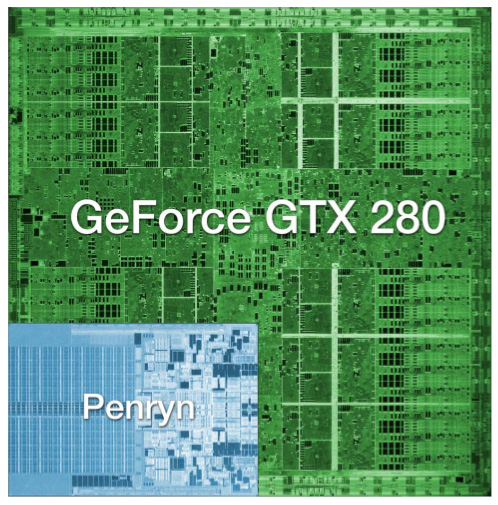
Well, the semiconductor world has our first giga-transitor chip as shown in AnandTech: NVIDIA's 1.4 Billion Transistor GPU: GT200 Arrives as the GeForce GTX 280 & 260. Check out the article's die shot, which compares the GT200 GPU next to an Intel Penryn CPU. What a tour de force! Imagine all the EDA tools that chip must have broken, leaving vendors quaking in their shoes. :-)

In reading up on Carl Sagan,

  • I was reminded of the petty and very amusing feud between Sagan and Apple Computer.
  • I learned that "the indefinite and fictitious number Sagan has arisen in popular culture to indicate a count greater than 4 billion." Thanks to Moore's Law, we'll see the first "Sagan-chip" before you know it.

Thursday, June 19, 2008

Mendence, the Merger

We have to come up with a clever name for the combination of Cadence and Mentor. Chris Edwards coined* Cadentor, which is actually a pretty decent name. Going the other way, Mendence is too close to "menace" or "mendacity", so I suppose the PR types won't buy that. (When AMD bought ATI, the irreverent press dubbed it DAAMIT.)

Cadence's unfriendly bid to acquire Mentor Graphics is red meat for the EDA blogoshpere! (Be sure to click on that link. It's a fascinating one-page summary of dozens of EDA news & opinion sources.)

I've read many thoughtful commentaries on the possibility. Frankly, most of them are unfavorable on the deal. Some of the substantial analyses:

Two of the more curious quips I read:

  • Customers don't want the EDA vendor to provide a complete front to back flow. They want best of breed tools, and for third party companies to link them together. I agree that we need best of breed tools, but not that we need third party companies to hook them together. Are there examples of companies that make a good business of that? That sounds like an ASIC company, and they aren't exactly thriving. There also used to be a company called Reshape that had their own physical design flow on top of commercial tools. But they ended up going out of business.
  • Cadence acquiring Mentor could present a big challenge to Synopsys. Well, I don't know. When two established giants come together, what technological advance does that enable? Not much that I can see. A bigger challenge is when a giant acquires a startup with hot new technology: think Cadence with Get2Chip, or potentially Mentor with Sierra Design Automation. One successful big acquisition was Synopsys acquiring Avant! -- I don't know what went on under the covers, but the products were complementary and continued to be successful after the deal was done.

    Of course, there may be "business synergies" -- cutting common administrative and infrastructure costs, and having a bigger menu for "all you can eat" deals. But it's kind of sad if one of the biggest business events in EDA just comes down to that.

*Update: Gabe Moretti lays claim to coining "Cadentor". I'll let Chris and Gabe hash it out.

Tuesday, June 17, 2008

NEWS FLASH: Cadence Proposes to Acquire Mentor Graphics

And then there were three? This just in: Cadence Proposes to Acquire Mentor Graphics for $16.00 per Share in Cash.

What is Mentor good at? I haven't used their tools recently, but by reputation I think they're strong at

  • DFT (FastScan)
  • LVS/DRC (Calibre)
  • Simulation (former ModelSim)
  • Certain pieces of Place & Route (Sierra)

So, does Cadence need some or all of these pieces because they're not strong? That's certainly the case for DFT: Mentor is a leader and Cadence is an also-ran. Or are they just "buying" Mentor's customer base?

UPDATE: Other blog reactions:

  • Cool Verification. A verification tools perspective.
  • EDA Thoughts. No, honestly -- tell us what you really think of the merger!
  • EDA Cafe. Several news releases, including Cadence's own presentation on the deal.
  • Sramana Mitra on Strategy. She's been calling for a consolidation in EDA, or some kind of shakeup in the business model. Her post has a good selection of links to her previous writings on the EDA business. This post also has the best comments thread on the topic.

Thursday, June 12, 2008

One More Thing: Apple to Tackle Parallel Computing

Image:Steve Jobs.jpg Apple in Parallel: Turning the PC World Upside Down? - Technology - New York Times Blog quotes Steve Jobs in a discussion of harnessing multi-core computing:
Apple, he asserted, has made a parallel-programming breakthrough.

It is all about the software, he said. Apple purchased a chip company, PA Semi, in April, but the heart of Snow Leopard will be about a parallel-programming technology that the company has code-named Grand Central.

“PA Semi is going to do system-on-chips for iPhones and iPods,” he said.

Grand Central will be at the heart of Snow Leopard, he said, and the shift in technology direction raises lots of fascinating questions, including what will happen to Apple’s partnership with Intel.

Snow Leopard will also tap the computing power inherent in the graphics processors that are now used in tandem with microprocessors in almost all personal and mobile computers. Mr. Jobs described a new processing standard that Apple is proposing called OpenCL (Open Compute LibraryComputing Language) which is intended to refocus graphics processors on standard computing functions.

“Basically it lets you use graphics processors to do computation,” he said. “It’s way beyond what Nvidia or anyone else has, and it’s really simple.”

Since Intel trails both Nvidia and A.M.D.’s ATI graphics processor division, it may mean that future Apple computers will look very different in terms of hardware.

Will OpenCL be an alternative to NVIDIA's Cuda software interface? Read the comments in the NY Times blog for some good technical analysis and the usual passion that surrounds any Apple pronouncement.

Update: see a thoughtful perspective in Chris Edward's blog.